

Feminine Energy in Relationships: The Secret to Attract Love?
by Anna H.
The feminine is a powerful force in love and relationships. When we speak of being in your feminine energy in relationships, we usually mean things like:
- being fully open with your partner
- expressing your emotions without fear of judgment or overthinking
- embodying your nurturing nature
- creating emotional safety
- allowing yourself to receive
- releasing the need for control
- embracing softness and sensuality
While these sound (and are!) lovely, there is also plenty of content out there trying to teach you to "use" feminine energy to "make him chase you", "get him back", "become wildly attractive", "attract quality men" or "get anything you want from a man" (not my words, all of these are real titles out there).
And... that's where it gets problematic.
I understand the appeal of these promises, of course. Who wouldn't want the relationship of their dreams? Unfortunately, following that kind of advice blindly might just get you the opposite.
So, let's talk about it: why some of the advice you see online is flawed, what research actually says about feminine energy in relationships, and what wisdom hides underneath it all. Because there is something valuable there, it just needs some healthy discernment.
This might not be the blog post you expected. But hopefully the one you need. Worth sticking around till the end 🙂
Why "using" feminine energy to attract love is problematic
Before we get to the beautiful side of feminine energy, let's just take a quick look at how it's often getting distorted:
#1 Love is not a game, nor a strategy to follow
The problem starts with the phrasing. "Using" something to "get" something? Meh. I'm all for women feeling powerful, but aren't we all done playing games?! That kind of language turns love into a transaction: If I act this way, I’ll get that outcome. It sounds tempting, but it's still dangerously close to control and manipulation.
The feminine has been undervalued for so long, so it’s natural that women want to reclaim their power. But real power isn’t about turning your partner into a puppet or measuring your worth according to how desirable you are to others.
Yes, leaning into your feminine side can be extremely healing and empowering, especially if it's something you've been suppressing. But please be mindful: Does the content you’re taking in make you feel more like yourself? Or does it make you feel like you need to adjust yourself? There’s a big difference between coming home to yourself and performing who you think you should be.
Real magnetism has nothing to do with playing a role. It’s the byproduct of being secure in yourself, just the way you are. It's the kind of confidence that doesn’t need to “use” anything (or anyone) to be felt.
#2 It's traditional gender scripts 2.0
99% of feminine energy content is directed at heterosexual women. We often hear this idea repeated: The more a woman is in her feminine, the more easily she will attract love, coming to her in the shape of a masculine man.
That kind of polarity dynamic resonates, yet the original idea of yin and yang is this: we embody both energies, no matter if you're a man or woman.
The way it’s often taught now feels like a spiritual rebrand of old gender roles. Women are told to be receptive and "let the man lead". Men are told to "claim their masculine power" and "take charge". We’ve seen that power dynamic before. When it’s framed this way, it can push women into being smaller, quieter, or less powerful – and we don’t need more of that.
While I get why a "traditional" relationship polarity might resonate and even work very well for some couples (if consciously chosen), we need to be careful what messages we're sending women.
(Strange, we never hear about how men are supposed to use their feminine energy to attract a good partner. Spoiler: we should, though, if we look at the science behind attraction in the next section!)
#3 The self-blame trap
Something else I sometimes see floating around in the feminine self-help space: Ideas along the lines of "If you keep attracting the bad guys / ended up single / he's distant / he's cheating / he isn't emotionally available, that's because you are too much in your masculine / haven't healed enough / aren't high value enough / aren't allowing him to be a man / aren't embodying the feminine." etc etc.
It's many ways of saying: You are not good enough. It's your fault.
Yes, sometimes we do replay familiar but unhealthy patterns. But please let's stop blaming the victims.
You are not a never-ending self-fixing project, nor is it your fault if you have had bad experiences. We absolutely do not need to tolerate abusive behavior or take accountability for someone else's faults.
Also: Personal growth is fantastic, but do it for yourself, not to please someone else. I want to live in a world where women are loved exactly for who they are. Not one where they are made to believe that being less feminine makes them less lovable.
What research says about feminine energy in relationships
So, what do studies actually say about men being drawn to "feminine" qualities like softness, nurturance, or emotional receptivity? This is where things get interesting.
Let's first look at initial attraction: A 2021 meta-analysis by Whyte et.al. looked at what men and women value in potential partners across multiple studies. It found that men, on average, placed greater importance on physical attractiveness and body build than women did; while women cared more about resources, education and intelligence. When it comes to personality factors like openness, trust and emotional connection, both sexes were roughly aligned in their preferences.
So what about long-term attraction? Both men and women consistently rank kindness, emotional stability, intelligence, and warmth among the most desired qualities in a partner. Buss (2019) found this pattern across 37 cultures; Malouff et al. (2010) and Valentine et al. (2020) confirmed it through meta-analyses.
So basically, the joke's on all of us: it’s not that men are drawn to feminine energy – it’s that everyone is. We ALL crave partners who embody qualities traditionally labeled as "feminine": empathy, receptivity, emotional depth, and most of all, the ability to connect. It's what makes us feel seen and safe in a relationship.
The psychology beneath the surface: what helps us attract a healthy relationship
If we translate the feminine energy advice into actual psychological concepts, we find a lot of familiar ground:
-
Receptivity = our desire for secure attachment
In a secure relationship, you feel safe being close to others and letting them in. -
Surrender = vulnerability + the ability to trust
Intimacy always carries uncertainty; we cannot love deeply without risking being seen fully. In a healthy relationship, you do not need to grasp for control, because there is a foundation of deep trust. -
Softness = emotional regulation and safety
We don't want to be in relationships with robots, nor do we want constant drama or loud conflict. When we express emotions without defensiveness or judgment, we do create a sense of softness and safety. -
Embodiment = nervous system regulation
If we want to connect deeply, knowing how to help your body return to a state of balance is essential. Being in touch with your body becomes the antidote to numbing out or overthinking.
When stripped to its core, much of what we mean by feminine energy just points to emotionally mature behavior. Behavior we want to see in both women and men.
So, why did this concept explode, particularly among women, in the last decade? I think we all feel the exhaustion of modern life. Even dating has become exhausting. Most of us operate in “masculine mode” 24/7: planning, chasing, optimizing.
The feminine energy narrative promises a return to ease – something we've come to crave more than anything.
In reality, of course, love is more complex. It's a commitment to constantly evolving together, showing up for yourself and for your partner. It’s the steady work of learning, unlearning, and meeting each other again and again.
Being in your feminine won't magically get you a partner or fix your relationship. But it can help you reconnect with parts of yourself you might have buried under constant doing and striving. And hopefully, that’s what makes space for real connection.
What feminine energy actually gets right about love and attraction
So, now we know there’s a reason this concept resonates. Underneath it all lie many psychologically sound ideas – they just don't necessarily need gendered packaging. Whether you're a woman or a man, your relationships will very likely benefit from embracing the following:
1. Choose softness over defensiveness
At its best, your relationship feels like a safe haven. One where you can fully be yourself, where you can let yourself be soft without getting hurt.
In moments of tension, softness breaks the cycle of reactivity. When you meet your partner with gentleness instead of defensiveness, it signals safety. Your tone, your body language, your presence: they all tell the other person, you don’t have to armor up here. That safety is what allows honesty to happen. People open up when they don’t feel like they’re about to be judged or attacked.
Stay curious about your partner's experience instead of defaulting to defense. Softness in a relationship creates emotional safety and closeness.
⚠️ Softness doesn't mean becoming a doormat, or being completely passive. Don't tolerate behavior that hurts you because confrontation feels "too masculine." Pair your softness with healthy boundaries: being gentle doesn't mean being endlessly available.
2. Tapping into attraction and desire
At its core, “attract, don’t chase” reminds you to stop forcing connections that feel one-sided. I 100% agree with the notion that you should know your worth and not desperately run after someone who isn't available. You don't need to convince someone to choose you.
Taken too literally though, it turns passive or into a game. Be clear about your intentions (yes, that may feel vulnerable). Don't play hard to get – or they'll be gone. Nothing is more magnetic than someone who’s open about wanting you and self-respecting enough to walk away if it’s not mutual.
Attraction works best when it’s shared. Take turns initiating, reaching out, planning, showing up. We all want to feel desired, but expecting one person to do all the "chasing" creates imbalance. Healthy relationships are built on reciprocity, not pursuit.
3. The art of receiving
This one has been a game-changer for me personally: learning to receive. Do you naturally deflect every compliment someone tries to give you? Do you always feel like you have to do everything on your own?
Many women have been forced to become hyper-independent. Many men have been taught they always need to be strong. Both benefit from learning to ask for – and accept – help, and accepting the kindness someone else extends to them.
Love is giving and receiving. Unfortunately, many women are so used to over-giving that they are plain exhausted. They desperately crave a partner who sees them, woos them, puts in the effort. They want to finally receive at the same level they’ve always given. When that finally happens, it can feel strange or even hard to accept, like you don’t quite know how to let it in. Learning to receive is all about allowing the same amount of love you put out into the world to come your way and truly believing: I deserve this.
And by the way... you don't need to play the damsel in distress to make your man/partner feel like he's needed. Feeling needed (in a healthy way) isn’t about dependence or helplessness. It’s about mattering. It's about showing that your presence, help, input, or care genuinely makes a difference. And that, again, is something that goes both ways. Feeling needed isn’t a male craving; it’s a human one.
Yes, be appreciative of your partner. Show you notice acts of care, see the things they do for you. But again: Know you deserve to be equally appreciated.
4. Surrendering
Secretly, we're little control freaks. Okay, maybe not everyone – feel free to skip this – but enough of us to make this paragraph worth writing.
The thing is: trying to control everything is exhausting. And many of us take this need to control and perfect and micromanage every aspect of our lives into our relationships.
The result? Tension. Nagging, overthinking, reading between the lines, quiet resentment, you name it.
The antidote? Surrender. Surrendering is rooted in trust. And trust is, without question, one of the most essential building blocks for a fulfilling relationship.
Surrendering means letting go of the need to control every detail. It means allowing life to unfold, and trusting your partner to show up in their way (even when it's slightly different from what you imagined). You don't need to try to fix everything, nor does everything need to go according to plan. If we release the chokehold we have on life, we may even find out that things turn out better than we expected.
Start allowing space for things to happen naturally. Trust that you and your partner can handle whatever comes up. And most importantly, choose to be present with each other and meet each other as you are.
⚠️ Again, a little disclaimer: surrender isn’t submission. It’s not about giving up your agency or letting your partner make all the decisions for you (if you enjoy letting them take the lead once in a while, that's fine, but always remember you are the one in charge of your life).
5. Being over doing
Much of our world is still built around masculine principles: Productivity. Achievement. Ambition. And the pace of modern life just keeps increasing. Without the much-needed balance of the feminine, is it surprising we're collectively stressed out?
We all need to make room for relaxation, for rest. Let your relationship be a place where you can exhale and simply be together. Not glued to your phones or already thinking about the next thing. Simply spending quality time together, being bored together, looking at the birds together, mindfully savoring a meal without distractions. When you create space for calm, you create space for connection.
There will be enough times when you will have to take action together, make decisions and push through challenges. Rest (or: the art of slowing down and simply being) is what allows you to actually feel each other and make room for things to emerge that often go unsaid in the business of our lives.
Enjoying the beauty of feminine energy in relationships (without losing yourself)
Positive feminine energy in a relationship feels like safety, like home. It is the very foundation true belonging is built on.
It's the ability to connect deeply, to listen with empathy, the gift of turning ordinary moments into intimacy. It's a way of saying: I see you.
When embodied consciously, this energy doesn't manipulate. There's no need to "use" this power. Being caring and compassionate is powerful in its own right.
And, as researcher Brené Brown reminds us, we cannot build connection without vulnerability:
“To love is to be vulnerable. To give someone your heart and say, ’I know this could hurt so bad, but I’m willing to do it. I’m willing to be vulnerable and love you.’ And there is an increasing number of people today that are not willing to take that risk. They’d rather never know love than to know hurt, or grief – and that is a huge price to pay.”
– Brené Brown
So, be coureagous. Allow yourself to be soft.
Whether you are hoping for a new love to enter your life or working on your current relationship, I wish you the gift of being fully present, fully yourself, and open enough to let in honest connection when it shows up.
That's the real magic of the feminine.
Continue the journey
Ready to live this, not just read about it? 🌙
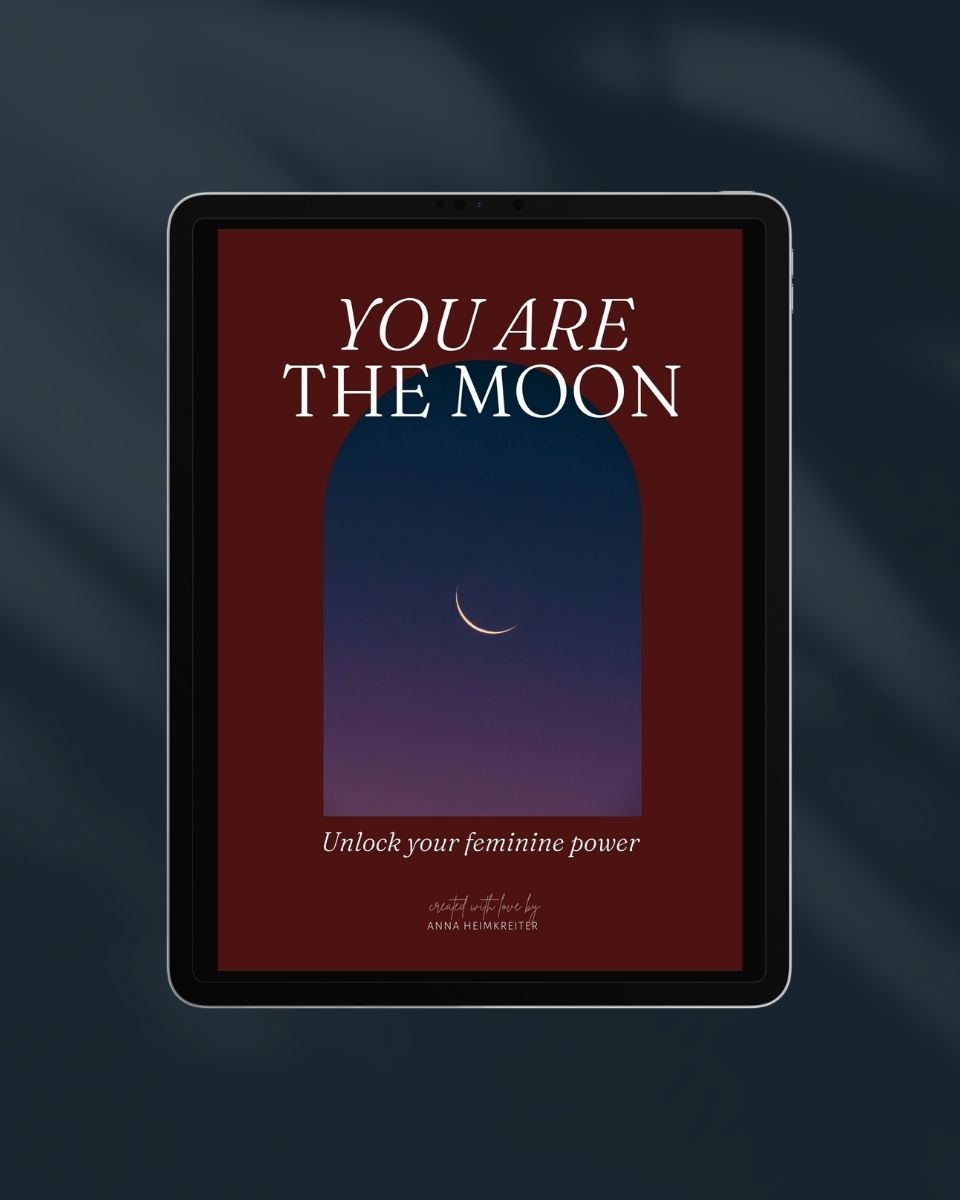
You Are The Moon is a feminine energy journal that helps you unlock the transformative gifts of the divine feminine. A guided return to intuition, emotional depth, and softness.
Quick navigation